

With the in-depth advancement of the “dual carbon” strategy and the accelerated construction of smart cities, the road lighting industry is entering a new stage of high-quality development. As the core component determining the performance of LED street lights, the driving power supply has ushered in more stringent industry requirements, becoming a key link in promoting energy conservation, emission reduction and intelligent upgrading of outdoor lighting, according to industry insiders at the 2026 Lighting Forum held recently.
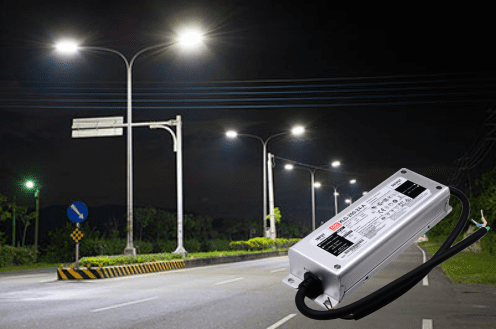
Electrical performance remains the primary criterion for LED street light power supplies, with energy efficiency and stability as the core. Affected by outdoor power grid fluctuations, the power supply must support a wide input voltage range of AC 85V ~ 265V to ensure stable operation in remote areas and regions with unstable voltage. Constant current output is mandatory, with an accuracy of ±3% ~ ±5% to maintain uniform brightness and avoid light source attenuation. Industry standards require a power conversion efficiency of no less than 89%, while high-end products have reached 92% ~ 95%, and the power factor (PF) of high-power models must be ≥0.95 to reduce grid interference and energy waste.
Adaptability to complex outdoor environments is another key requirement. The power supply must withstand extreme temperatures ranging from -40℃ to +60℃, maintaining over 80% power output even at -25℃. A protection level of IP65 or higher (preferably IP67) is essential for dust, rain and water spray resistance, while coastal areas require additional salt spray resistance passing 48-hour tests. Lightning protection complying with IEC 61000-4-5 Class standards is also indispensable to avoid damage from lightning surges.
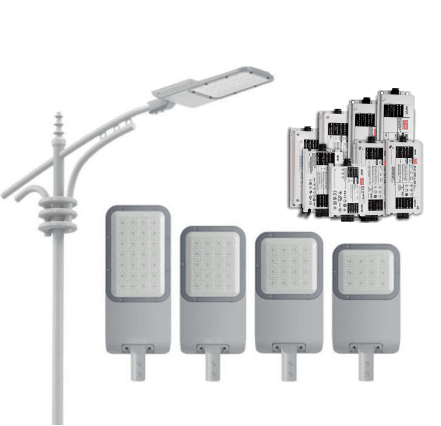
Safety, reliability and long service life are non-negotiable for outdoor applications. The power supply must be equipped with five protection functions: overvoltage, overcurrent, overtemperature, short circuit and undervoltage, with a response time of ≤50ms and automatic recovery after fault elimination to ensure the safety of the power supply and light source. It must also comply with safety standards such as GB 19510, CE and UL, and meet GB 17625 requirements for electromagnetic compatibility to avoid interfering with traffic signals and communication equipment, with a mean time between failures (MTBF) of ≥50,000 hours to adapt to long-term outdoor operation needs.