
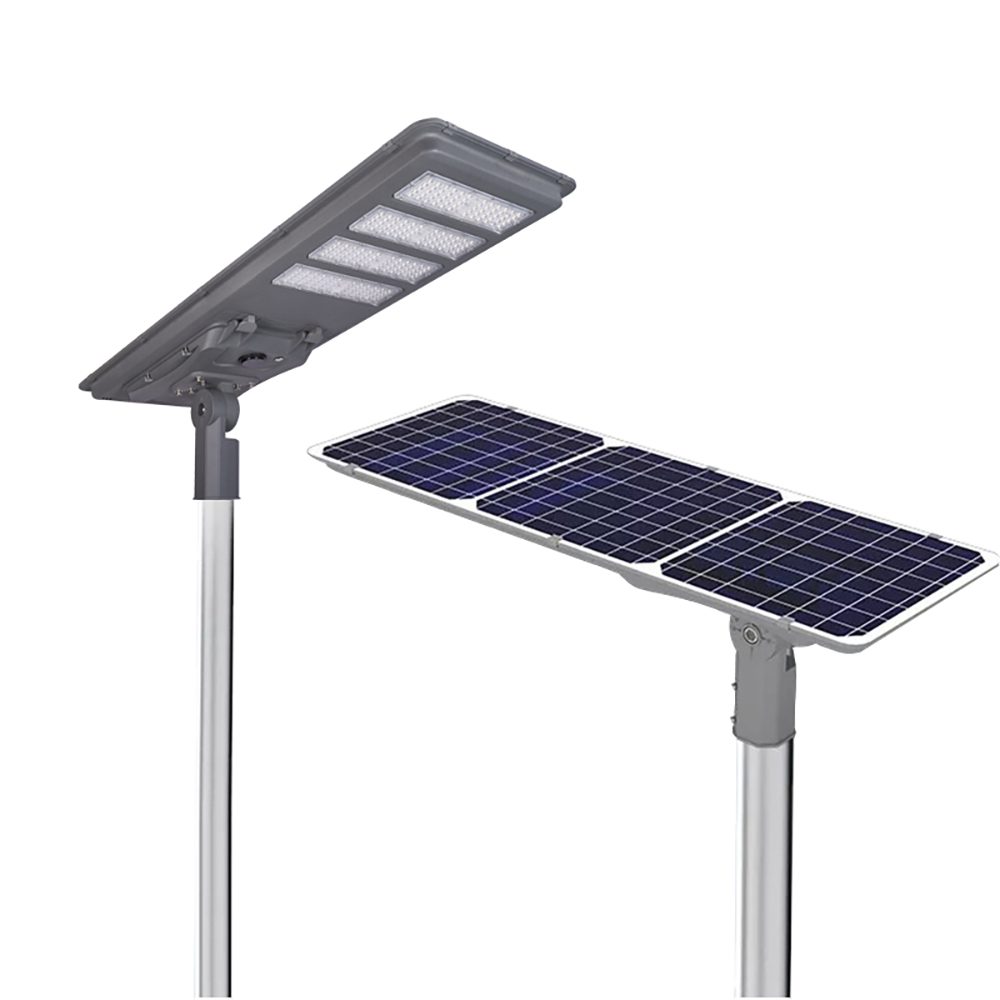
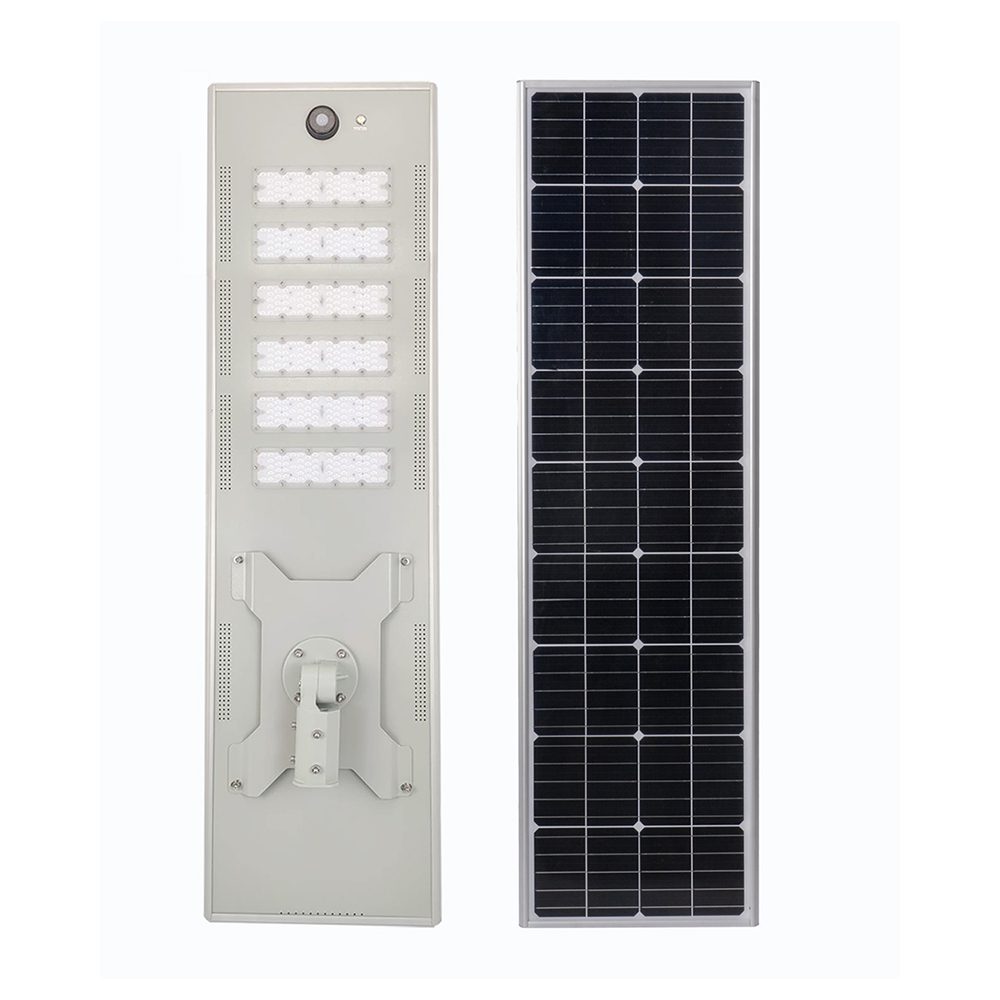

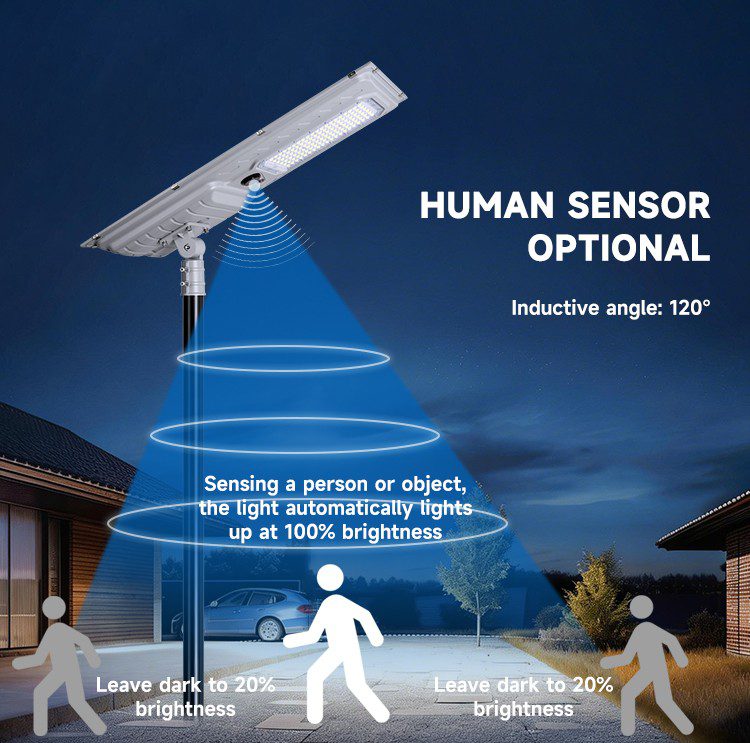
Motion sensor function has become a very common feature in modern solar street lights. In many product inquiries, buyers even expect motion detection and dimming control as a standard configuration. This is especially true for residential solar lights, rural lighting systems, and energy-saving outdoor projects.
However, from a professional lighting perspective, motion sensor is not just a “smart feature.” It is closely related to solar energy limitations, battery design, and real application environments. Understanding why it is widely used, and when it is actually necessary, helps buyers make more practical decisions instead of simply adding features without purpose.
1. Why Motion Sensor Is So Common in Solar Lighting
Unlike AC-powered street lights, solar street lights depend completely on stored energy in batteries. This means energy management becomes the key factor in system design.
At night, the system must decide how to distribute limited battery power over several hours of operation. Motion sensor technology helps solve this problem by controlling brightness intelligently.
In most solar lighting systems, the working logic is typically:
the light stays at low brightness during idle periods, and switches to full brightness when movement is detected.
This approach significantly reduces energy consumption while still ensuring safety when people or vehicles are present. It also allows smaller battery configurations to support longer working hours, which is very important for cost control in solar projects.
In short, motion sensing is widely used because it improves battery efficiency, extends runtime, and helps solar lighting systems remain stable even under limited charging conditions.
2. PIR Sensor: Simple and Cost-Effective Solution
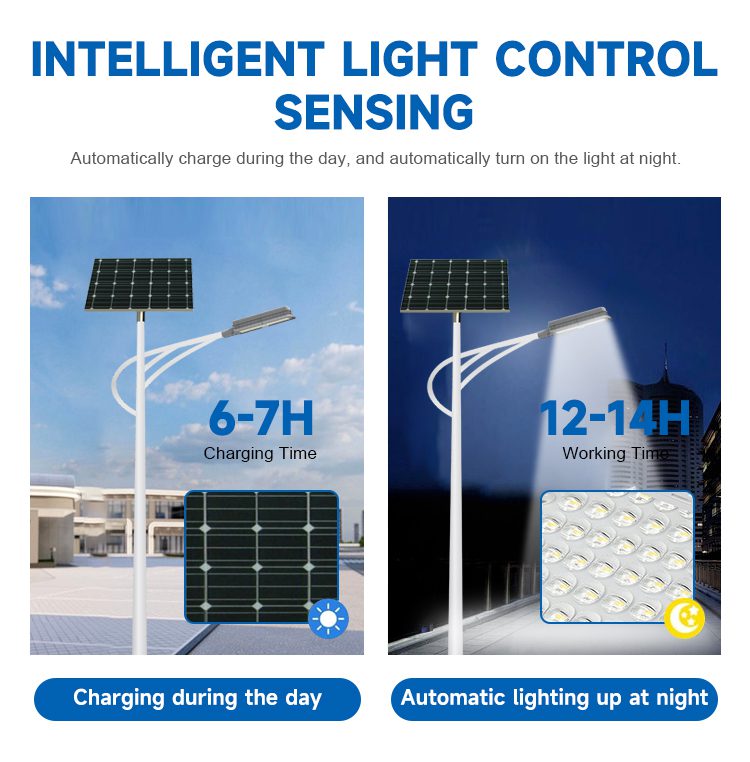
PIR (Passive Infrared) sensors detect human or vehicle movement by sensing infrared heat differences. When a warm object enters the detection area, the sensor triggers the lighting change.
PIR sensors are widely used because they are simple, stable, and cost-effective. They do not emit signals but only receive infrared changes, which makes them energy-efficient and easy to integrate into solar lighting systems.
In real applications, PIR sensors are most suitable for short-distance detection environments such as residential pathways, gardens, villa driveways, and small community roads. In these areas, movement is usually close to the fixture, and the traffic level is relatively low.
However, PIR sensors also have limitations. Their detection performance can be affected by environmental temperature, and their range is relatively limited. In hot climates, the temperature difference between the human body and surroundings becomes smaller, which may reduce sensitivity.
3. Microwave Sensor: More Advanced Detection Technology
Microwave sensors work on a different principle. Instead of detecting heat, they emit microwave signals and analyze the reflected waves to identify movement.
This makes microwave sensors more sensitive and capable of detecting motion over longer distances. They also perform better in complex environments and are less affected by temperature changes compared with PIR sensors.
Because of these advantages, microwave sensors are often used in larger or more demanding projects such as highways, industrial areas, large parking lots, and security-focused lighting systems. They can detect vehicles and pedestrians more effectively across wider coverage areas.
However, microwave sensors are usually more expensive and may occasionally react to non-target movements in highly reflective environments. This means they are better suited for performance-oriented applications rather than low-cost residential projects.
4. How PIR and Microwave Differ in Real Projects
Although both technologies are used for motion detection, their practical application scenarios are quite different.
PIR sensors are more suitable for short-range, cost-sensitive, and low-traffic environments. They are simple, reliable, and widely used in residential and small-scale solar lighting systems.
Microwave sensors, on the other hand, are designed for wider coverage, higher sensitivity, and more complex outdoor environments. They are more suitable for industrial and public infrastructure lighting where detection reliability is more important than cost.
In practical engineering design, the choice is not about which technology is better overall, but which one matches the project conditions more appropriately.
5. When Do You Actually Need Motion Sensor Function?
Although motion sensors are widely used, they are not necessary for every solar lighting project.
In residential applications such as gardens, backyards, and private driveways, motion sensors are very useful because they reduce energy consumption and provide comfortable lighting only when needed. They also help avoid excessive brightness during low-activity hours.
In rural and off-grid areas, motion sensors play an even more important role. Since solar energy collection may be unstable due to weather conditions, reducing energy usage at night helps ensure the system can operate throughout the entire night.
In small commercial or semi-security environments such as storage yards or low-traffic parking areas, motion sensing also improves efficiency while maintaining basic safety.
However, in high-traffic roads, urban streets, and continuous lighting projects, motion sensors are often unnecessary. These environments require stable and consistent illumination to ensure traffic safety and visibility at all times.
6. Balance Between Smart Function and System Simplicity
While motion sensor technology improves energy efficiency, it also increases system complexity. More components mean more control logic, and in some cases, slightly higher cost or maintenance considerations.
This is why professional lighting design always focuses on balance rather than feature stacking. In solar lighting systems, the best configuration depends on actual usage conditions, not on adding every available function.
If energy saving is a priority, motion sensors are very valuable. If lighting must remain stable and continuous, constant output mode is more appropriate. If cost control is important, PIR sensors are usually sufficient, while microwave sensors are selected when higher detection performance is required.
7. Conclusion
Motion sensor function has become a standard feature in solar street lights because it directly improves energy efficiency and extends system runtime under limited solar power conditions.
PIR sensors provide a simple and cost-effective solution for residential and small-scale applications, while microwave sensors offer higher sensitivity and better performance for large or complex environments.
However, motion sensing is not a universal requirement. In many continuous lighting scenarios such as main roads or urban streets, stable illumination is still the preferred solution.
Understanding the differences between these technologies allows buyers and project designers to choose more suitable solar lighting configurations based on real application needs, ensuring better performance, efficiency, and long-term reliability.