

1. Lighting Standards
According to “Lighting Design and Testing Standards for Sports Venues” (JGJ 153-2016) and “Technical Requirements for LED Sports Lighting Applications” (GB/T 38539-2020), the lighting standards for badminton courts are as follows:
Horizontal illuminance: The average horizontal illuminance on the court should not be less than 300 lx. For commercial competition and athlete visual comfort, an average illuminance of 500 lx or higher is recommended, with an illuminance uniformity (U0) of not less than 0.7.
Vertical illuminance: Vertical illuminance on the court should not be less than 150 lx.
Correlated color temperature (CCT): Recommended between 4500 K and 5700 K to provide a comfortable environment for competition and spectatorship.
Color rendering index (CRI): Not less than 80 to ensure accurate color reproduction on the court.
2. Considerations for Badminton Venue Lighting
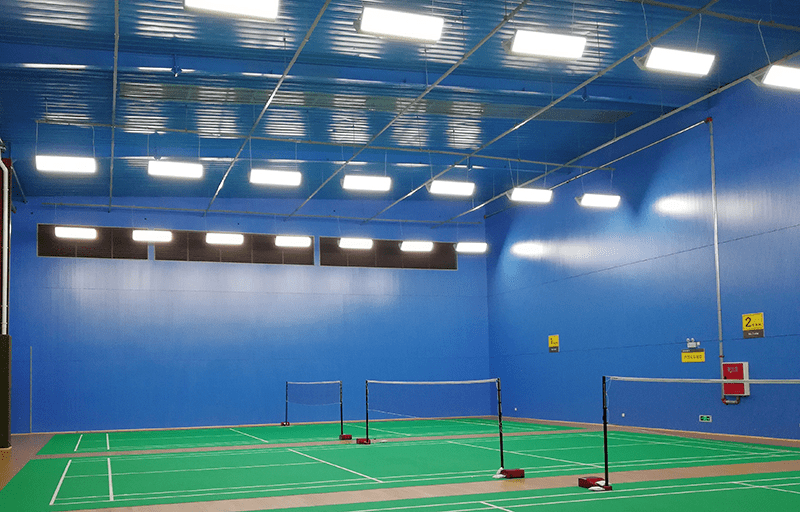
Avoid glare: Fixture layout should avoid direct light into spectators’ eyes and minimize glare. Where unavoidable, apply glare-control measures to luminous surfaces.
Uniform illumination: Avoid bright spots and dark areas to ensure even illuminance across the playing area.
Spatial lighting: Badminton involves objects (shuttlecocks) moving at varying heights; vertical illuminance is a critical indicator of spatial visual clarity. Note that some deep-lensed fixtures can provide adequate ground-level horizontal illuminance but create insufficient overhead illuminance between fixtures, making the shuttlecock difficult to see for players.
High contrast: To ensure players can clearly distinguish the typically white shuttlecock from the background, the lighting system should provide sufficient contrast. This often means selecting background finishes (floor, walls, curtains, spectator seating) that contrast with the shuttlecock—darker background materials can help the white shuttlecock stand out. Reducing illuminance in areas behind players or in spectator seating can also improve perceived contrast.
Energy efficiency and environmental considerations: Prioritize high-efficiency, energy-saving LED fixtures to reduce power consumption and operating costs.
Intelligent control: Smart controls simplify lighting management, reduce wiring/grouping costs, and enable demand-based lighting and energy-saving strategies.
3. Relevant Technical Terms
Illuminance: The luminous flux received per unit area, used to measure how bright a surface is (unit: lux).
Color temperature: The temperature of a black body radiator that emits light perceived to be the same color as the light source (unit: kelvin, K).
Color rendering index (CRI): A measure of a light source’s ability to render object colors faithfully compared to a reference; higher values indicate more accurate color rendering.
Glare: A visual condition caused by unsuitable luminance distribution or extreme brightness contrast in space or time that leads to visual discomfort and reduced object visibility.
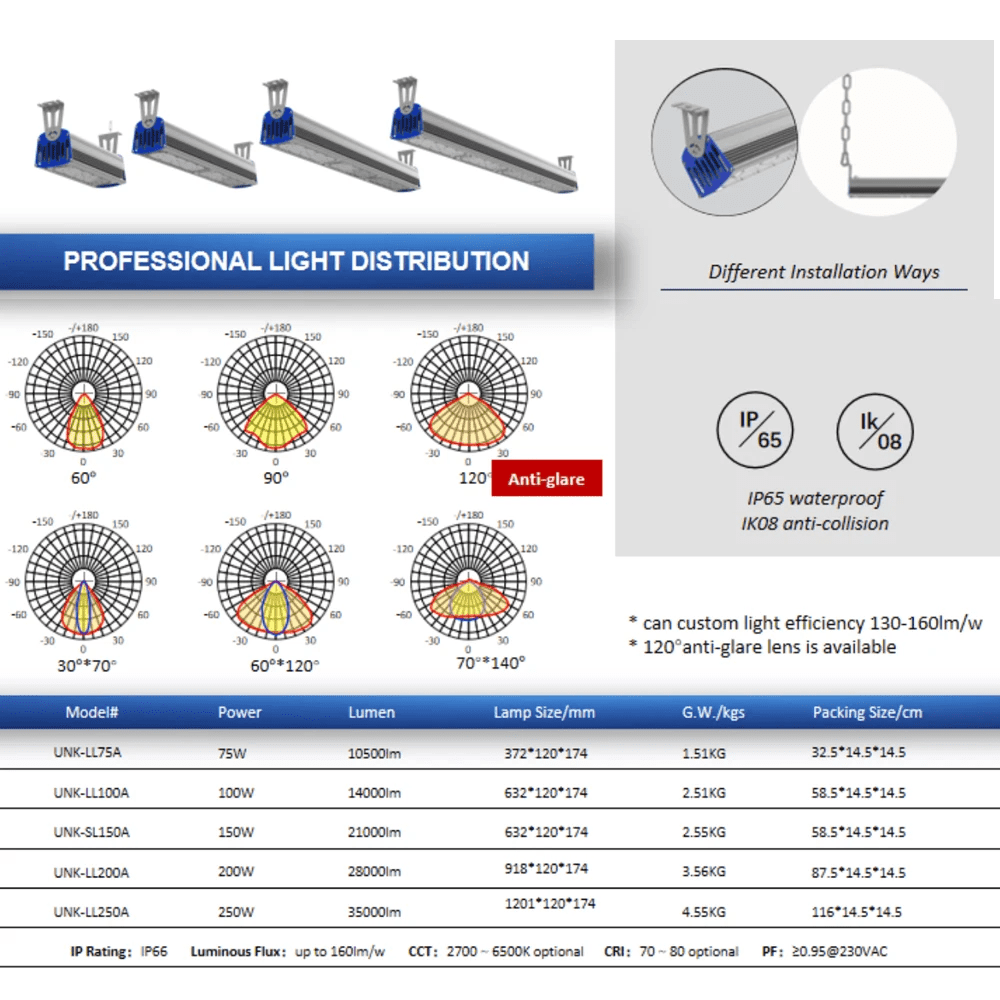
Luminous flux: A measure of the total light output of a fixture (unit: lumen, lm). Higher lumen indicates greater light output.
Lamp power: The electrical power consumed by the light source; it directly affects lighting performance and energy consumption. Choosing appropriate power balances lighting quality and energy use.
Luminaire efficacy / efficiency: The efficiency of converting electrical power to visible light; higher-efficiency fixtures reduce energy consumption while providing adequate illumination.
Maintenance factor: Accounts for light depreciation and dirt accumulation over time; it reflects how well a fixture maintains luminous flux during use.
4. Fixture Layout and Mounting Height
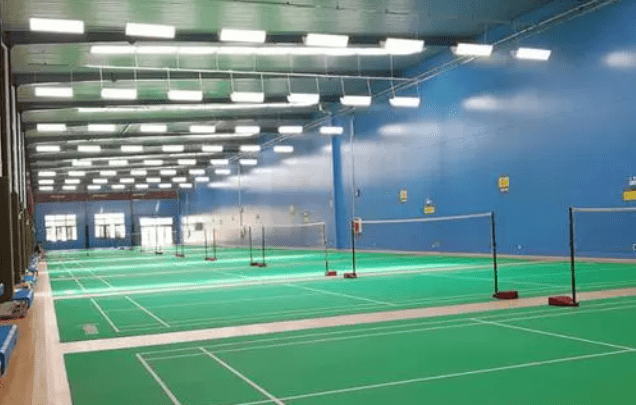
Layout methods: Commercial badminton halls commonly use symmetrical arrangements along the two sides, or a uniform ceiling-mounted layout. The layout must ensure even coverage of the entire court and avoid creating glare.
Mounting height: Determined by court size and fixture type; a typical recommended mounting height is between 6 m and 8 m above the playing surface.
5. Fixture Requirements
High efficiency: Fixtures should have high luminous efficacy to reduce energy consumption.
Long life: Fixtures should offer long service life to reduce maintenance costs.
No flicker: Fixtures must be flicker-free to avoid discomfort for players and spectators.
Safety: Fixtures should meet requirements for electrical safety, fire resistance, and other relevant protections.
Badminton court lighting design must follow relevant standards to ensure lighting quality, energy efficiency, and safety. Through appropriate fixture layout, careful product selection, and attention to key parameters, one can achieve a high-quality lighting environment that meets the needs of athletes and provides a comfortable viewing experience for spectators.